


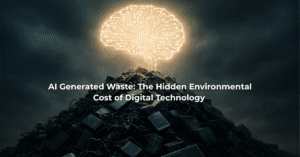
The Invisible Carbon Footprint of AI
Artificial Intelligence (AI) has quickly become part of our daily lives. It’s powering everything from search engines and virtual assistants to supply chain logistics and medical breakthroughs. But behind the innovation lies a growing environmental problem few are talking about: AI-generated waste.
Every time we use AI tools — from ChatGPT queries to automated image generators — vast data centres crunch through immense amounts of information. This process consumes enormous amounts of electricity and water. According to the UN Environment Programme (UNEP), AI technologies depend on “energy-hungry digital infrastructure” that already contributes significantly to global greenhouse gas emissions (UNEP, 2024).
Training a single large AI model can emit as much carbon dioxide as five cars over their entire lifetimes, according to a 2023 Guardian analysis (The Guardian, 2023). As AI adoption accelerates, so does its demand for energy – and in turn, the waste and emissions linked to powering and cooling these enormous systems.
Data, Devices, and Digital Debris
The environmental impact of AI isn’t just about electricity. It’s also about the physical waste it leaves behind.
Every new data centre requires thousands of servers, processors, and cooling systems – all of which eventually become electronic waste (e-waste). Globally, e-waste is growing at nearly 5% per year, and Ireland is among the highest per-capita producers in Europe. According to the Environmental Protection Agency (EPA), Ireland generated approximately 68,000 tonnes of e-waste in 2023 – an amount expected to rise with increasing digital infrastructure and smart devices.
AI’s rapid pace of technological advancement exacerbates this problem. As hardware becomes obsolete faster, older equipment is discarded – often before it can be responsibly recycled or refurbished.
(If you’re wondering about Ireland’s Recycling Rates and how they measure against EU Targets, read our article: Why Recycling Matters: Ireland’s Waste Targets Explained.)
Ireland’s Role in the Digital Energy Equation
Ireland sits at the heart of Europe’s digital revolution – but also its energy dilemma. Our mild climate, strong fibre networks, and corporate tax incentives have made us a hub for data centres, which now consume 22% of Ireland’s total electricity use, according to EirGrid (2024).
That figure is projected to rise to nearly 30% by 2030, raising concerns about national sustainability targets and grid resilience. Researchers at the University of York argue that “decarbonising digital infrastructure” must become a global priority — including a shift toward renewable energy and smarter, more efficient computing systems (University of York, 2025).
This isn’t just an energy issue – it’s a waste management issue, too. The more servers and electronic systems we rely on, the more materials we’ll eventually need to recycle, repurpose, or safely dispose of.
(For businesses managing technology upgrades, proper disposal is key. You can easily arrange an environmentally responsible collection through hireaskiponline.ie’s commercial skip hire and waste removal services.)
Can AI Be Part of the Solution?
Despite its environmental footprint, AI may also help us fight the very problem it contributes to. Researchers at MIT are exploring how AI can optimise data centre cooling, reduce power consumption, and model global climate systems more efficiently (MIT News, 2025).
Similarly, AI-driven systems are helping recycling facilities improve sorting accuracy, identify contamination, and even detect illegal waste dumping — all of which could help Ireland move closer to a true circular economy.
But to balance AI’s promise with its environmental impact, both governments and companies will need to make serious commitments: to green energy, sustainable design, and responsible e-waste management.
Summary
AI is reshaping industries, economies, and everyday life — but it’s also reshaping our planet. Behind the digital convenience lies a web of energy consumption, hardware waste, and carbon emissions that demands attention. Ireland, as a data hub, faces unique challenges — but also opportunities to lead in sustainable innovation.
The future of technology doesn’t have to be wasteful. With smarter policies, renewable power, and responsible recycling, the AI revolution could become not just intelligent — but sustainable.
FAQs
Q: What is AI-generated waste?
It refers to the energy, e-waste, and environmental impact linked to powering, producing, and maintaining AI systems. From data centre emissions to hardware disposal.
Q:How much electricity do Irish data centres use?
As of 2024, around 18% of Ireland’s total electricity, with projections of up to 30% by 2030 (EirGrid).
Q: Can AI really help the environment?
Yes. AI is being used to improve energy efficiency, track pollution, optimise waste management, and develop cleaner production methods. However, there needs to be responsibility when it comes to development.
Q: What can individuals and businesses do?
Reduce digital waste by maintaining devices longer and using renewable-powered services. Always ensure all electronics are recycled or disposed of safely through licensed waste providers.

