


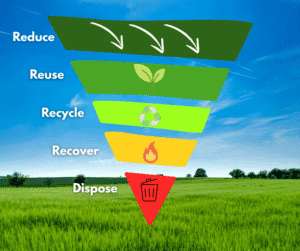
Every waste removal job is part of a bigger environmental picture. The waste hierarchy is a globally accepted framework that ranks waste management methods from most to least environmentally responsible. Whether you’re a DIY renovator, a contractor, or just ordering through hireaskiponline.ie, understanding and applying this hierarchy helps reduce waste, save resources, and protect our planet.
What is the Waste Hierarchy?
The waste hierarchy is a five-level pyramid—rooted in the EU’s Waste Framework Directive—that prioritises waste management practices:
1. Prevention & Waste Reduction – Stop It Before It Starts
Prevent waste before it’s produced. This is perhaps the most important, and most difficult step in The Waste Hierarchy. Particularly when companies deliver everything we order with excessive and unnecessary packaging waste – from cardboard, to plastic, to polystyrene. Here are some tips to help prevent and reduce waste:
- Know what you need and plan carefully to avoid over-ordering materials.
- Choose durable, minimal-packaging supplies, sourced locally.
- Design with modularity in mind—so parts can be reused or replaced.
Preventing waste saves resources, cuts costs, and reduces the need for other methods of disposal. Similarly, by following these steps and reducing your waste – you also reduce energy consumption, greenhouse gas emissions and labour costs.
2. Reuse – Giving Items a Second Life
Repair, refurbish, and donate where possible. Who knows? Other people might have uses for your waste! (And you might even make a few euros)
- Clean and restore items like doors, windows, bricks, or timber.
- Repurpose structurally sound fixtures in other projects or sell them second-hand.
- Donate usable materials to local reuse centres.
This approach greatly reduces skip volume while promoting circular reuse. For instance, instead of discarding an old, dirty, and flaking wardrobe that came with my property, I invested a little time and effort into stripping, sanding, and varnishing it. In the end, I was able to sell it on Facebook Marketplace—not only re-using waste but also making a bit of money in the process!
For more information and ideas on how to reuse your waste, take a look at WasteOnline’s blog. I loved their idea of reusing old plastic bottles as funnels for bird feeders.
3. Recycling – Transforming Waste into Resources
Turn materials back into something useful. Recycling is the most well-known tier in the waste hierarchy, and for good reason! Ireland has made strong progress in recycling, with packaging recycling rates reaching 62% in 2021 — above EU targets — though household recycling rates remain lower at around 40%. Recycling helps reduce landfill waste, cuts greenhouse gas emissions, and conserves valuable raw materials. For every tonne of paper recycled, up to 17 trees are saved, while recycling aluminium uses 95% less energy than producing it new. Improving recycling habits can deliver major environmental and economic benefits nationwide. Here are some tips to help with recycling your waste:
- Sort waste into separate channels: timber, metal, cardboard, plasterboard, etc.
- Send to authorized recycling processors to ensure proper material reuse.
- Even organic waste can be composted to return nutrients to the soil.
This lets you lower the use of virgin materials and can reduce the need for a larger-sized skip for your project– take a look at MyWaste’s website to find your local recycling centre in Ireland.
4. Recovery – Extracting Value Before Disposal
One of the main ways of ‘recovering’ waste is through Waste-to-Energy (WtE). This is a process that recovers energy or materials when recycling isn’t practical, converting waste materials into forms of energy, like electricity or heat, that can then be used. Here’s some more information on waste recovery:
- Use processes like anaerobic digestion or energy-from-waste incineration.
- For example, modern facilities like the Dublin Waste-to-Energy Facility (The Poolbeg Incinerator) transform household rubbish into electricity and even heating, while capturing metals for recycling. So far, it has diverted over 4 million tonnes of waste from landfills and generated 3,000 GWh of renewable electricity – heating around 50,000 homes in the area!
- Despite the benefits of Waste-to-Energy recovery processes, there’s a reason it’s so low on the Waste Hierarchy funnel. It produces High CO2 emissions, it also has the potential to destroy recoverable materials, as much as it recovers them. Similarly, there are concerns about it disincentivising recycling and fuelling an unregulated waste trade – for example, developed countries ‘pawning’ off their waste on developing countries for processing. Oftentimes, this is so countries can claim they’re improving their recycling rates, when in reality the waste is incinerated or used in WtE facilities. This is exemplified by China’s National Sword Policy.
This is why reducing, reusing and recycling your waste is always preferable, where possible.
5. Disposal – The Last Resort
Disposal = Landfills. And it’s hard to find anything positive to say about landfills—they’re bad news all around. Decomposing waste produces methane—a powerful greenhouse gas—along with pollutants that damage air quality, contaminate soil and water through toxic leachate, and impact human health. Wildlife is also affected through habitat loss, disrupted ecosystems, and exposure to toxins. Although Ireland has reduced municipal waste to landfill from over 80% in the early 2000s to about 15% in 2022, landfills remain a major source of pollution and long-term environmental burden. But they beat fly-tipping, so here’s some tips to dispose of your waste responsibly.
- Ensure waste is sent to licensed landfills.
- Keep records and documentation for regulatory compliance.
Disposal remains the least sustainable option and should be the fall-back, not the first choice. Always make sure to use a registered and licensed waste removal service. If your waste ends up being fly-tipped or dumped, you could be liable!
At HireASkipOnline, we make it our duty to make sure your waste is handled and disposed of responsibly, according to environmental regulations – protecting both the planet, and yourself. Book your skip today!
Applying the Hierarchy with Skip Hire
Skip hire doesn’t just remove waste—it offers the opportunity to align with green principles:
- Make sure to pick the right skip for your project with our Skip Sizes Explained guide. This way, you won’t need waste money having to order a replacement or getting one too large!
- Segregate waste to maximize reuse and recycling before it enters the skip.
- Document your hierarchy approach, especially for hazardous or mixed wastes.
- Use a licensed provider like hireaskiponline.ie for compliant waste collection and disposal.
Real-World Context: Ireland’s Waste Strategy
The National Waste Management Policy and the EU Waste Framework Directive guide Ireland’s journey toward sustainable waste management. Recycling targets and landfill taxes are key tools to enforce the hierarchy in practice.
Success stories like the plastic bag levy (over 90% drop in use) and WEEE regulations driving electronics recycling highlight the power of policy in enforcing waste hierarchy principles.
FAQs
Q: What is the primary goal of the waste hierarchy?
To preserve resources and reduce environmental impact by following a structured waste management approach: Reduce → Reuse → Recycle → Recover → Dispose.
Q: Is recycling always the best option?
Not necessarily—it depends. Recycling uses energy and infrastructure, so if reuse or prevention are viable options, those are better choices.
Q: How can contractors implement this hierarchy on site?
Start with precise material orders, salvage usable components, sort materials, and use energy recovery when necessary—all before even hiring a skip.
Q: Why hire through hireaskiponline.ie?
Our clear pricing, varied skip sizes, and responsible disposal practices support the waste hierarchy every step of the way.
Summary:
The waste hierarchy helps you rethink how waste is managed—from avoiding it at source to responsible final disposal. By integrating this approach into projects and skip hire practices, you minimise waste, protect resources, and comply with legislation. Smart choices, planned properly, mean skips don’t just carry away rubbish—they deliver sustainability.
References:
Central Statistics Office (2025) Environmental indicators Ireland 2024Â Waste Environmental Indicators Ireland 2024.) Â Available at: https://www.cso.ie/en/releasesandpublications/ep/p-eii/environmentalindicatorsireland2024/waste/ (Accessed: 26 August 2025).
Environmental Protection Agency (2024) Ireland’s recycling rate has not improved in a decade: It is time to move away from a wasteful linear economy, Ireland’s Recycling Rate. Available at: https://www.epa.ie/news-releases/news-releases-2024/irelands-recycling-rate-has-not-improved-in-a-decade-it-is-time-to-move-away-from-a-wasteful-linear-economy-.php (Accessed: 26 August 2025).
Ward, S. (2025) Transforming waste into energy: Dublin waste-to-energy’s vision for the future, Transforming Waste Into Energy. Available at: https://www.energyireland.ie/transforming-waste-into-energy-dublin-waste-to-energys-vision-for-the-future/ (Accessed: 26 August 2025).
Guberman, R. (2021) The Pros and cons of waste-to-energy: RTS, The Pros and cons of waste-to-energy. Available at: https://www.rts.com/blog/what-is-waste-to-energy/ (Accessed: 26 August 2025).

