


 Ireland is more environmentally aware than ever. Recycling bins are colour-coded, awareness campaigns are constant, and climate change regularly tops public concern polls. Yet contamination rates remain stubbornly high, recycling centres reject loads daily, and illegal dumping persists across both urban and rural areas.
So why, despite knowing better, do people still recycle incorrectly — or not at all?
The answer lies less in information and more in human psychology. Recycling isn’t just a systems problem; it’s a behavioural one. Understanding how people think about waste — and why intentions don’t always translate into action — is essential if Ireland is to improve recycling outcomes.
For households and businesses dealing with larger waste volumes, services like HireASkipOnline.ie can help simplify disposal early in the process — but behaviour remains the first hurdle.
Out of Sight, Out of Mind: How We Mentally “Lose” Waste
One of the most consistent findings in waste psychology research is that people emotionally disconnect from waste the moment it leaves their hands. According to behavioural studies explored by ISB Global, once an item is discarded, it becomes psychologically “invisible” — reducing feelings of responsibility for its final destination.
This helps explain why contamination occurs even among well-intentioned recyclers. Items that feel recyclable — coffee cups, greasy pizza boxes, mixed plastics — are often placed in recycling bins despite being unsuitable. This phenomenon, known as “wish-cycling,” allows people to feel environmentally responsible without verifying accuracy.
As R. O’Randall’s work on the psychology of waste explains, waste transitions rapidly from something useful to something unwanted, triggering avoidance rather than engagement. Once something is labelled “rubbish,” people want it gone — fast.
Impact in Ireland:
Contaminated recycling loads can be rejected entirely, sending recyclable materials to landfill or incineration instead — undermining Ireland’s recycling targets.
To read more about Ireland’s recycling targets, take a look at our blog ‘Why Recycling Matters: Ireland’s Waste Targets Explained’.
Good Intentions, Bad Habits: Why Awareness Campaigns Plateau
Ireland’s recycling campaigns have successfully raised awareness — but awareness alone doesn’t guarantee behaviour change.
Research summarised by UniSort and ScienceDirect highlights a consistent gap between environmental intention and real-world action. People overestimate how often they recycle correctly and underestimate how complex waste sorting actually is.
Common behavioural barriers include:
- Cognitive overload: Too many rules, symbols, and exceptions
- Inconsistent systems: Different councils, different bin rules
- Time pressure: Convenience beats correctness in busy households
Simply put, when recycling feels inconvenient or confusing, people default to the quickest option — even if it’s wrong.
This explains why illegal dumping still occurs despite widespread understanding that it’s harmful. Behaviourally, dumping often stems from frustration, perceived cost, or lack of accessible disposal options — not ignorance.
However, this does not extend to organised waste crime, where dumping is often seen as a source of income for criminal enterprises. For more information on this topic, take a look at our article ‘Empire of Waste: Criminal Gangs, Fly-Tipping and Waste Crime’.
Bins Matter More Than We Think: Design Shapes Behaviour
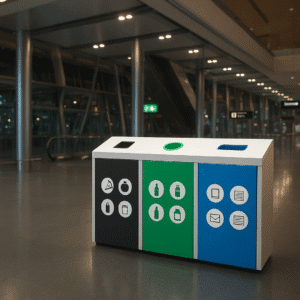 Surprisingly, the design and placement of bins play a major role in recycling accuracy.
Research discussed by Take Our Trash shows that:
- People recycle more when bins are visible and clearly labelled
- Confusing colours or unclear signage increase contamination
- Proximity matters — people are less likely to recycle if bins are inconvenient
This is why public spaces with poorly marked bins often suffer from mixed waste, even among environmentally conscious users. Behaviour follows path of least resistance, not intention.
In Ireland, inconsistent bin colours between councils further reinforce confusion. When people move counties — or even towns — previously learned habits can backfire.
For larger clear-outs, renovations, or business waste, simplifying disposal with a licensed provider — such as booking a skip via HireASkipOnline.ie’s online system — can reduce sorting fatigue and prevent contamination at source.
Social Norms, Shame, and “Everyone Else Does It”
Recycling behaviour is strongly influenced by social norms. According to Psychology in Perspective, people are more likely to recycle correctly when they believe others around them do the same.
Conversely, littering and dumping can spread when communities perceive it as common or tolerated. This explains why dumping hotspots persist — visible waste lowers the psychological barrier for further dumping.
Shame also plays a role. When people are unsure about recycling rules, they may avoid engagement entirely rather than risk being “wrong.” This is particularly relevant for complex waste streams like textiles, electrical items, or renovation debris.
Ireland’s growing textile waste problem highlights this challenge, explored further in our article on what happens to waste after collection — where improper disposal often begins at household level.
Bridging the Gap: What Actually Changes Recycling Behaviour
Behavioural research consistently shows that simplification, not education alone, drives better recycling outcomes.
What works:
- Fewer, clearer rules
- Consistent bin systems nationwide
- Immediate feedback (e.g. bin tags, contamination notices)
- Making the correct option the easiest option
Ireland’s next recycling gains won’t come from telling people why recycling matters — but from redesigning systems so that doing the right thing feels automatic.
For households or businesses generating bulky or mixed waste, choosing structured disposal options early — such as skip hire — reduces the chance of mis-sorting later in the chain.
Summary
Ireland’s recycling struggle isn’t about apathy — it’s about human behaviour. People care, but habits, convenience, confusion, and social cues often override intention. Solving the problem means designing waste systems that work with psychology, not against it.
By simplifying disposal choices, standardising systems, and removing friction, Ireland can turn environmental awareness into real-world impact.
FAQs
Why do people recycle incorrectly even when they care about the environment?
Because recycling decisions are influenced by habit, convenience, and confusion — not just awareness.
What is wish-cycling?
Placing items in recycling bins in the hope they’re recyclable, even when unsure — often increasing contamination.
Does bin design really affect recycling behaviour?
Yes. Research shows clear labels, consistent colours, and visibility significantly improve correct use.
How can households reduce recycling mistakes?
By learning local rules, avoiding wish-cycling, and using structured disposal options for large or mixed waste.
Is skip hire more environmentally responsible than multiple tip trips?
When used correctly with licensed providers, skip hire can reduce illegal dumping and improve waste sorting efficiency.

