


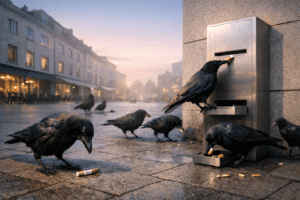
Crows as Cleanup Crews? Sweden’s Wildlife Waste Solution
If we were to imagine walking through a modern city street and witnessing a flock of crows methodically retrieving discarded cigarette butts, depositing them into a machine in exchange for food, the scene might appear faintly dystopian – a tableau more reminiscent of speculative fiction than municipal policy, or a fable about nature correcting human excess. However, this image has not been confined to abstraction; in Sweden, it’s now a potential reality.
In Södertälje, Sweden, startup Corvid Cleaning proposed training wild crows to collect cigarette butts — one of the most common and persistent forms of litter — using a reward-based system that could, in theory, cut municipal cleanup costs significantly. The idea has since sparked debate not only about innovative waste management but also about the ethical boundaries of using wildlife to solve human problems.
If you’re interested in waste management innovations and what waste management will look like in the future, take a look at our blog series The Future of Waste. Here, we discuss topics like the Psychology of Waste, AI-Generated Waste, Rewilding with Drones and other breakthroughs in Biofuel, Battery Sustainability and Smart Bins.
The Corvid Cleaning Concept: How It Works
The core of Corvid Cleaning’s idea is deceptively simple: leverage the remarkable intelligence of crows to reduce one of the most ubiquitous forms of urban litter — cigarette butts — using a positive reinforcement system.
Corvid Cleaning developed “bird bin” stations: receptacles designed to accept cigarette butts and automatically dispense a small amount of food — often peanuts — each time a crow deposits a butt. The birds involved are wild and voluntary participants, not captive animals forced into behaviour.
Advocates of the concept have pointed out two key reasons for choosing crows:
- According to a research paper published by the University of California, crows are among the most intelligent birds, with reasoning abilities comparable to those of a seven-year-old child.
- Their social learning capabilities mean trained behaviours can spread through a local population of birds.
Estimates from the Keep Sweden Tidy Foundation suggest that cigarette butts make up around 62% of litter in some Swedish towns, costing millions of kronor annually to collect. Proponents argue that, if effective, birds could reduce these costs by up to 75% in theory.
Environmental Realities and Human Responsibility
On the surface, this story is a clever example of thinking outside the box in waste management and citing a crow’s intelligence, sprinkled with promising statistics is all well and good but — but it also underscores a deeper, more uncomfortable truth about littering and environmental behaviour. If a crow voluntarily exchanges labour for food, does that absolve the litterer? Or does it subtly reinforce a system in which human convenience is preserved at the expense of a species’ health?
Cigarette butts aren’t just tiny pieces of rubbish: they’re composed primarily of cellulose acetate plastic, which can persist in the environment for years and leach harmful chemicals into soil and water. These plastics are a form of micro-pollution that affects wildlife far beyond city streets.
Imagine, then, wild birds consistently picking up these toxic remnants in order to earn a treat — feeding back into a system created by consumer behaviour. Corvid Cleaning’s concept forces us to confront the question: are we outsourcing the consequences of our own habits to other species?
In urban settings here in Ireland, litter such as cigarette butts, plastic waste or construction debris often ends up in public spaces — or worse, in waterways and coastlines — because of human behaviour. Skip Hire or licensed waste removal services can mitigate these problems by making responsible disposal easier and more systematic.
Beyond the Birds: What This Means for Waste Management
If nothing else, Corvid Cleaning’s concept highlights a persistent challenge in waste management: people still generate litter — and solutions that rely solely on reactive cleanup (whether by animals, machines, or workers) can never fully replace preventive approaches.
The Swedish pilot has captured attention precisely because it is novel. But novelty should not obscure proportionality. Waste management, at its core, is less about spectacle and more about systems: infrastructure, accessibility and behavioural design.
This is not a call to reject experimentation. Environmental progress has often emerged from unconventional thinking. For example, innovations in gamified recycling and behavioural incentive design (smart bins etc.) increasingly attempt to confront waste at its source – reshaping human habits rather than merely managing their aftermath. However, solutions that obscure root causes — excessive consumption, casual disposal, infrastructural gaps — risk becoming performative rather than transformative.
At HireASkipOnline.ie, we work to make the waste management process straightforward, compliant, and tailored to each project’s needs — whether that’s for domestic renovations or larger commercial cleanups.
Summary
The idea of training crows to pick up cigarette butts in exchange for a treat is as fascinating as it is provocative. It highlights both the ingenuity and the absurdity inherent in seeking solutions to litter created by human behaviour. Corvid Cleaning’s pilot in Sweden sparked conversation about costs, intelligence, and innovation, but it also raises deeper questions about where responsibility truly lies.
Rather than outsourcing environmental stewardship to other species, long-term change depends on human behaviour — from better waste design and disposal practices to broader cultural shifts around litter and consumption.
And where human behaviour still struggles to keep pace with environmental need, responsible waste services — from recycling initiatives to licensed skip hire — remain essential tools in reducing litter, protecting communities, and preserving ecosystems.
FAQs
Q: Did crows successfully clean streets in Sweden?
The pilot concept was proposed and trialled in Södertälje, but broader deployment beyond pilot stages hasn’t been widely documented.
Q: Are cigarette butts dangerous to wildlife?
Yes — they contain toxic residues and plastics that can harm animals and leach into soil and water over time.
Q: Is this method a legitimate waste solution?
While innovative, many experts see it as impractical for large-scale waste management compared to systemic human behaviour change.
Q: What are better ways to reduce littering?
Prevention through education, better waste infrastructure, and responsible disposal systems often yield more sustainable outcomes.
Q: How does skip hire help reduce litter?
Licensed skip hire provides a responsible way to collect and remove large volumes of waste — from household revamps to construction debris — reducing the chance of materials entering public spaces.

