

Gamified Recycling for Consumer Engagement
Recycling is something most people know they should do — yet bins are still misused, contamination remains high, and participation rates plateau. As explored in our article on The Psychology of Waste: Why Ireland Still Struggles to Recycle Properly, awareness alone doesn’t always translate into action.
So, what if recycling felt less like a chore — and more like a game?
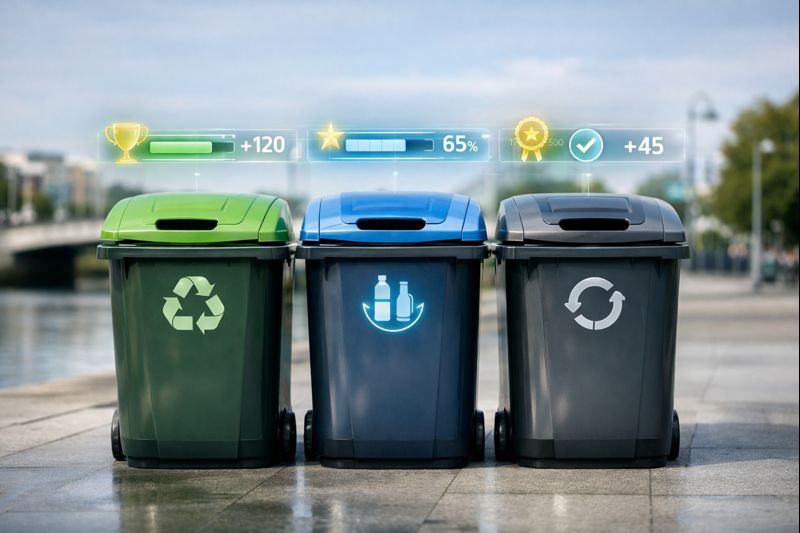
Gamified recycling is emerging as a powerful behavioural tool, using rewards, feedback loops and competition to encourage better waste habits. From smart bins that award points to apps that track recycling “streaks”, gamification is increasingly being tested as a way to turn good intentions into consistent action.
This article explores how gamification works, why it’s effective, and whether it could help Ireland improve recycling outcomes — while acknowledging its limits.
What Is Gamified Recycling?
Gamified recycling applies game design elements — such as points, challenges, rewards and leaderboards — to everyday waste behaviours. The goal isn’t entertainment for its own sake, but behaviour change through motivation.
Common examples include:
- Reward points for recycling correctly
- Digital badges for completing recycling challenges
- Competitions between households, schools or communities
- Instant feedback showing environmental impact saved
According to The Traceability Hub, gamification works because it turns abstract environmental benefits into immediate, visible outcomes, which people are far more likely to respond to.
Rather than asking people to “do the right thing”, it makes the right thing feel rewarding.
Why Gamification Works: The Psychology Behind It
Behavioural research consistently shows that humans respond better to positive reinforcement than to guilt or punishment.
Academic studies published in Science Direct and analysed in multiple gamification research papers show that recycling behaviour improves when systems tap into:
- Immediate rewards (dopamine response)
- Progress tracking (goal completion)
- Social comparison (seeing others participate)
- Loss aversion (not wanting to miss out on rewards) .
This aligns closely with findings discussed in Make Waste Fun Again, which found that users were significantly more engaged when recycling was framed as a challenge rather than a responsibility.
In short, people don’t recycle more because they care more — they recycle more because the system makes it easier, clearer, and more satisfying.
Real-World Examples of Gamified Recycling
Retail and Consumer Incentives
Retailers across Europe and the UK have experimented with deposit rewards, discounts, and loyalty points for returned packaging. Sherwen highlights examples where consumers receive store credit or vouchers in exchange for recycling specific materials.
These systems work best when:
- Rewards are immediate
- Instructions are simple
- Feedback is visible at the point of action
Smart Bins and Technology
Smart recycling bins equipped with QR scanners or RFID tracking allow users to log recycling actions via apps. According to Method Recycling, these tools can increase participation but must be carefully designed to avoid confusion or fatigue.
Community-Based Challenges
Community competitions — such as neighbourhood recycling targets or school-based challenges — leverage social norms. When people believe others are participating, they are far more likely to join in themselves, as shown in multiple behavioural studies.
Challenges and Limitations of Gamification
While promising, gamified recycling is not a silver bullet.
Short-Term Engagement
Several studies note that engagement can drop once rewards are removed. If systems rely too heavily on incentives, behaviour may not stick long-term.
Complexity Risks
Overly complex apps, unclear rules or inconsistent rewards can actually reduce participation — reinforcing the confusion many people already feel around recycling.
Cost and Scalability
Technology-driven systems require investment, maintenance and data protection — challenges for local authorities and small communities.
This is why gamification works best when combined with clear bin design, consistent rules, and accessible disposal options — including traditional solutions like skip hire for large or mixed waste loads.
For households or businesses managing significant waste volumes, using a licensed skip service like HireASkipOnline.ie can often be more practical than relying solely on household recycling systems.
Where Gamification Fits into Ireland’s Waste Future
Ireland faces ongoing challenges with contamination, illegal dumping and recycling confusion. Behavioural approaches like gamification could help — but only as part of a broader strategy.
When paired with:
- Clear national recycling rules
- Better bin labelling
- Convenient disposal options
- Responsible waste collection infrastructure
…gamification can reinforce good habits rather than replace fundamentals.
As explored in our article What Happens to Your Waste After Collection?, consumer behaviour is just one piece of a much larger waste system — but it’s a crucial one.
Summary
Gamified recycling offers a promising way to bridge the gap between awareness and action. By making recycling more engaging, visible and rewarding, it taps into how people actually behave — not how we wish they would.
However, its success depends on simplicity, trust, and integration with wider waste systems. When designed well, gamification can encourage better habits — but it works best alongside reliable, compliant waste services that handle what households and businesses can’t.
FAQs
What is gamified recycling?
It uses game-like elements such as points, rewards and challenges to encourage people to recycle correctly and consistently.
Does gamification really increase recycling?
Research shows it can improve participation and engagement, especially when rewards are immediate and systems are simple.
Are rewards necessary?
They help, but long-term behaviour change also depends on clarity, convenience and social norms.
Can gamification replace traditional waste services?
No. It works best as a complement. For large or mixed waste loads, skip hire often remains the most practical option.
Is gamified recycling used in Ireland?
Pilot projects and limited schemes exist, but widespread adoption is still emerging.

