


Waste crime costs governments, businesses and taxpayers millions every year, yet many offences go undetected or unpunished. While fly-tipping often makes the headlines, illegal waste activity extends far beyond abandoned sofas and black bags. It includes illegal waste sites, unlicensed carriers, hazardous waste offences and large-scale dumping by organised criminal groups.
If you’re planning a renovation or clearance project, using a licensed waste operator like Hire A Skip Online is one of the simplest ways to ensure your waste is handled legally. Our guide ‘Why Recycling Matters: Ireland’s Waste Targets Explained‘ explains how responsible waste management benefits both your project and the wider environment.
Waste Crime Is More Than Fly-Tipping
Many people associate waste crime with someone dumping rubbish on a country lane. In reality, regulators deal with a much broader range of offences.
Waste crime can include:
- Illegal dumping and fly-tipping
- Operating illegal waste sites
- Burning waste without permission
- Falsifying waste paperwork
- Illegal waste exports
- Operating without a valid waste carrier licence
These offences damage ecosystems, pollute waterways, increase fire risks and undermine legitimate businesses that invest in legal disposal and recycling. The Environment Agency describes waste crime as a serious threat to communities, the environment and compliant businesses.
Why Is Waste Crime So Difficult to Police?
Unlike many conventional crimes, waste offences often occur on private land, in remote locations or behind legitimate-looking businesses. By the time regulators discover an illegal site, the people responsible may have disappeared.
A recent comparative study published in Policing: A Journal of Policy and Practice examined waste crime investigations across Ireland, the UK, Canada and Australia. The researchers found several recurring barriers:
- Limited enforcement resources
- Delayed investigations
- Weak intelligence sharing between agencies
- Inconsistent multi-agency cooperation
- Difficulties gathering evidence before waste is moved
The study concluded that intelligence-led investigations are generally more effective than relying solely on public reports after offences have occurred. It also highlighted technologies such as drones and satellite imagery as underused tools for detecting illegal activity earlier.
Waste crime also differs from many other offences because evidence can disappear quickly. Waste may be removed, buried, burned or transported elsewhere before investigators arrive.
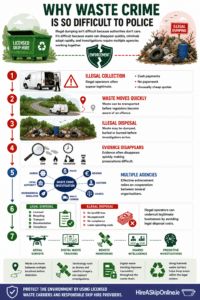
(Figure 1: Infographic explaining why waste crime is difficult to police, showing illegal collection, transport, dumping, evidence loss, enforcement challenges and how digital waste tracking can improve investigations.)
Low Risk, High Reward
One reason waste crime persists is simple economics.
Legal disposal carries genuine costs. Licensed operators must comply with environmental regulations, transport requirements, landfill tax, recycling obligations and record keeping. Criminal operators avoid many of these costs while charging customers seemingly competitive prices.
This creates what many regulators describe as a “low-risk, high-reward” crime.
The University of Birmingham notes that waste crime ranges from organised criminal networks to smaller operators cutting corners. These offenders respond differently to enforcement, making a single solution unlikely to succeed. The researchers argue that increasing penalties alone may not be enough if offenders believe the likelihood of being caught remains low.
In Northern Ireland, enforcement agencies have also warned that illegal disposal can cost offenders only a fraction of legal waste treatment, creating a strong financial incentive for rogue operators. This price gap makes legitimate businesses less competitive while encouraging illegal activity.
Enforcement Requires More Than Tougher Penalties
Calls for harsher punishments often follow major fly-tipping incidents. While stronger penalties can play an important role, experts increasingly argue that enforcement must become smarter rather than simply tougher.
Behavioural researchers at the University of Birmingham explain that effective deterrence depends on three factors:
- How likely offenders believe they are to be caught.
- How severe the punishment is.
- How quickly enforcement follows the offence.
If detection remains unlikely or investigations take years, tougher fines alone may have limited impact.
The Environment Agency has also emphasised that enforcement already ranges from advice and warning letters through to prosecutions, depending on the seriousness of each offence. The EPA also coordinates national environmental enforcement and works alongside local authorities to improve compliance and tackle serious waste offences.
Meanwhile, parliamentary committees have repeatedly highlighted that environmental regulators operate with finite resources while facing thousands of waste-related offences each year. Better intelligence, earlier intervention and stronger cooperation between agencies may deliver greater benefits than relying solely on prosecutions.
Can Technology Close the Enforcement Gap?
Technology is becoming one of the most promising weapons against waste crime.
Digital waste tracking could make it much harder for illegal operators to disguise where waste originated or where it ended up. GPS tracking, digital waste transfer records and automated reporting can improve traceability throughout the waste chain.
Investigators are also beginning to use drones, satellite imagery and remote sensing to identify illegal waste sites more quickly. These technologies allow regulators to monitor large areas without relying entirely on site inspections.
Artificial intelligence may also help identify suspicious disposal patterns, prioritise inspections and analyse intelligence more efficiently. While these tools cannot replace investigators, they can help direct limited enforcement resources where they are needed most.
This mirrors many of the developments already transforming legitimate waste management, from digital booking systems to predictive logistics and smarter recycling technologies.
What Can Householders Do?
Most householders never intend to contribute to waste crime, yet illegal dumping often begins with waste handed to an unlicensed carrier.
Before paying someone to remove waste, you should:
- Before handing waste to anyone, check that they are an authorised waste collector. Resources from MyWaste explain your household responsibilities, while the National Waste Collection Permit Office lets you verify registered waste carriers.
- Ask where your waste will be taken.
- Obtain receipts where appropriate.
- Be wary of unusually low prices.
Hiring a skip through a reputable provider offers greater confidence that waste will enter the legitimate waste management system.
If you’re planning a renovation, our Skip Size Calculator can help you choose the right skip for your project while reducing unnecessary collections. You may also find our article on The Psychology of Waste: Why Ireland Still Struggles to Recycle Properly useful for understanding the wider challenges facing waste management.
Need to dispose of renovation or household waste responsibly?
Choosing a licensed skip hire provider helps ensure your waste is handled legally, tracked correctly and taken to authorised recycling facilities. Book your skip online today for a simple, compliant waste disposal solution across Ireland.
Summary
Waste crime remains difficult to police because it combines environmental offences with organised criminal behaviour, financial incentives and limited enforcement resources. Stronger powers may improve investigations, but experts increasingly believe the greatest progress will come from combining better intelligence, behavioural insights and digital technologies.
Ultimately, preventing waste crime depends on everyone involved in the waste chain. Regulators, licensed operators, businesses and householders all have a role to play in ensuring waste is handled responsibly.
Frequently Asked Questions
What is waste crime?
Waste crime includes illegal dumping, fly-tipping, operating unlicensed waste sites, illegal waste transport, burning waste unlawfully and falsifying waste documentation.
Why is waste crime difficult to investigate?
Many offences occur in remote locations, evidence disappears quickly and enforcement agencies often have limited resources. Investigations also require cooperation between multiple organisations.
Are organised criminal groups involved?
Yes. Regulators increasingly treat serious waste crime as organised crime because of the profits involved and its links with wider criminal activity.
How can I avoid using an illegal waste carrier?
Always check that the business is registered, ask where your waste will be disposed of and avoid unusually cheap quotes that seem too good to be true.
Will technology reduce waste crime?
Digital waste tracking, GPS monitoring, drones and AI all have the potential to improve traceability and help regulators detect illegal activity more quickly, although experts agree they should complement, rather than replace, traditional investigations.

