

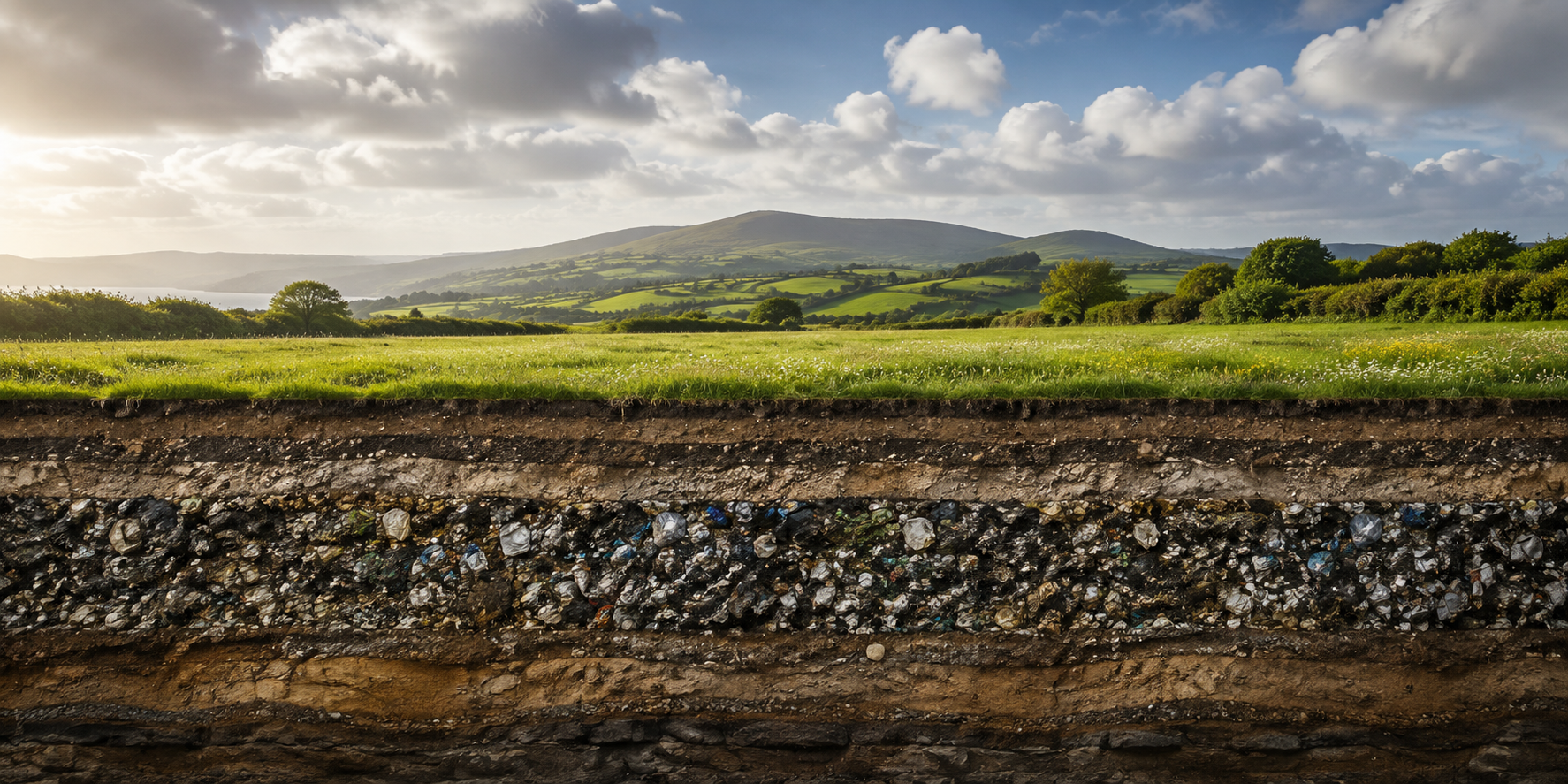
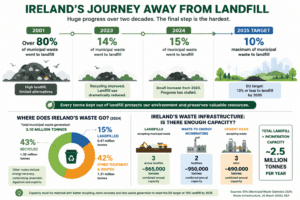
For decades, landfill was Ireland’s default solution for household waste. In the early 2000s, around 80% of municipal waste ended up buried in the ground. Today, that figure has fallen to just 15%—a remarkable environmental achievement driven by improved recycling, stricter legislation, and investment in modern waste infrastructure.
However, the job isn’t finished. Ireland still generated more than three million tonnes of municipal waste in 2023, and the European Union has set an ambitious target of reducing landfill to just 10% of municipal waste by 2035. Meeting that goal will require more than better disposal. It will demand waste prevention, smarter recycling, and a stronger circular economy.
If you’re planning a renovation or clear-out, responsible waste disposal starts with choosing the right solution. Hire A Skip Online’s team are dedicated to licensed and responsible waste removal, hoping to help Ireland reach it’s 2035 waste targets. To learn more, read our article Why Recycling Matters: Ireland’s Waste Targets Explained.
From Landfill Nation to Circular Economy
Ireland’s transformation has been significant, according to the Environmental Protection Agency (EPA), municipal landfill rates have fallen to approximately 15% of municipal waste generated. At the same time, recycling rates have improved, while a greater proportion of non-recyclable waste is now recovered through energy recovery rather than landfill. These changes have dramatically reduced methane emissions from waste disposal and helped Ireland align more closely with European environmental policy.
Several factors have driven this progress:
- The introduction of household recycling and brown-bin collections made it easier for households to separate waste correctly.
- Landfill levies increased the cost of disposal, encouraging greater recycling and recovery.
- Investment in modern waste treatment facilities reduced reliance on landfill while improving resource recovery.
The shift has also been supported by legislation. European waste policy prioritises prevention, reuse and recycling before disposal, forming the basis of the waste hierarchy that continues to shape Ireland’s waste strategy. To learn more about the Waste Hierarchy, take a look at our article: The Hierarchy of Waste: Waste Management Practices Explained
Why Landfill Still Matters
Although landfill now represents a much smaller share of Ireland’s waste, reducing it further remains important. Organic waste buried in landfill produces methane, a greenhouse gas significantly more potent than carbon dioxide over a 20-year period. Landfills also occupy valuable land, require long-term environmental monitoring, and represent a loss of materials that could otherwise be recycled or reused.
The European Environment Agency (EEA) continues to encourage Member States to divert waste away from landfill wherever possible, recognising landfill as the least desirable option after prevention, reuse, recycling and energy recovery. Every tonne diverted from landfill helps conserve resources while supporting Ireland’s climate commitments.
Ireland’s Landfill Capacity Is Under Pressure
Falling landfill rates do not mean Ireland has solved its waste capacity problem. In fact, the country faces a growing challenge around the availability of waste treatment infrastructure.
The latest EPA waste infrastructure data shows that only three landfills currently accept municipal waste in Ireland. Together, they have a combined capacity of around 865,000 tonnes per year. Ireland also has two waste-to-energy incinerators and three cement kilns accepting waste for co-incineration.
That capacity needs to serve a country that generated around 3.1 million tonnes of municipal waste in 2024. The EPA also forecasts that municipal waste generation will continue to grow, while recycling rates could remain largely stagnant without further intervention. This creates a difficult balancing act; Ireland needs to reduce the amount of waste going to landfill while ensuring enough treatment capacity remains available for residual waste that cannot be recycled or recovered.
The issue becomes more important as Ireland has fewer landfill sites than in previous decades. The EPA’s State of the Environment report notes that Ireland had three active landfills accepting municipal and other waste in 2023. This compares with six in 2016 and 125 in 1996. Recent concerns over Ireland’s waste disposal capacity have also prompted questions about whether more landfill and incineration capacity may be needed, as reported by the Irish Independent.
However, the answer cannot simply be to build more landfill capacity. Landfill remains the least preferred option in the waste hierarchy, and waste sent there can contribute to methane emissions. The EPA identifies landfill as the largest source of emissions within Ireland’s waste sector, although emissions have fallen as more waste moves towards recycling, composting, anaerobic digestion and waste-to-energy treatment. Instead, Ireland needs to expand recycling and recovery capacity while continuing to reduce waste generation. This includes better infrastructure for materials such as plastics, paper and cardboard, where the EPA identifies existing capacity limitations.
The pressure on Ireland’s waste infrastructure therefore reinforces the importance of keeping waste out of landfill wherever possible. Better recycling, reuse and waste prevention can extend the life of existing infrastructure while reducing the environmental impact of disposal.
Progress Has Slowed
Ireland has made impressive progress, but future gains will be harder to achieve. The EPA reports that municipal waste generation remains high, with over 3 million tonnes produced in 2023. Population growth, rising consumption and changing lifestyles continue to place pressure on waste services.
Some waste streams also remain difficult to recycle:
- Food waste continues to represent a substantial proportion of household bins despite widespread brown-bin collections.
- Contaminated recycling reduces the quality of recyclable materials.
- Construction, demolition and textile waste also present ongoing challenges as Ireland moves towards a more circular economy.
These issues highlight an important point; the next stage of progress is less about improving disposal and more about preventing waste in the first place.
If you’d like to understand why recycling behaviour often falls short despite good intentions, read our article The Psychology of Waste: Why Ireland Still Struggles to Recycle Properly, which explores the behavioural barriers behind everyday waste decisions.
Can Ireland Reach the EU’s 2035 Target?
Under revised European waste legislation, Member States are encouraged to reduce landfill waste to no more than 10% of municipal waste by 2035.
Achieving this target will require action across every stage of the waste hierarchy. Preventing waste before it is created remains the most effective solution. Products designed to last longer, better repair services and stronger reuse markets all reduce the amount of waste entering the system. Ireland’s Circular Economy Strategy reflects this shift. Rather than focusing solely on recycling, it encourages businesses and consumers to keep products and materials in use for as long as possible through repair, sharing, remanufacturing and reuse.
Food waste is another major priority. Preventing edible food from becoming waste reduces emissions while saving households money. Likewise, improving separate collection of textiles, electrical equipment and construction materials will help recover more valuable resources before disposal becomes necessary.
The challenge is no longer simply managing waste efficiently, it’s reducing the need to create waste at all.
What Irish Households Can Do
National targets depend on millions of everyday decisions and simple actions can have a measurable impact. For example, using the correct three-bin system helps reduce contamination and improves recycling quality. Household recycling centres accept many items that cannot be placed in kerbside collections. Citizen’s Information has a great article on how Irish households can reduce waste which you can access here.
For renovation projects, choosing an appropriately sized skip helps separate waste safely while ensuring materials can be processed through licensed facilities, we’ve developed a Skip Size Calculator to help making choosing the right skip size for your project simple. Responsible waste management also means working with licensed waste operators who ensure waste is handled legally and traceably from collection through to treatment.
Landfill Is No Longer the End of the Story
Ireland’s reduction in landfill represents one of the country’s biggest environmental success stories. However, the easiest gains have already been made, future progress will depend less on building new disposal facilities and more on preventing waste before it exists. That means designing products differently, reducing food waste, improving recycling quality and embracing circular economy principles across homes, businesses and construction projects.
Landfill may never disappear completely. But with continued investment, smarter policies and everyday behavioural change, Ireland has a realistic opportunity to move even closer to the EU’s 2035 target while protecting valuable natural resources for future generations.
Summary
Ireland has reduced municipal landfill from around 80% in the early 2000s to approximately 15% today through better recycling, legislation and modern waste infrastructure. Despite this progress, more than three million tonnes of municipal waste are still generated annually. Achieving the EU’s target of limiting landfill to 10% by 2035 will require greater waste prevention, improved recycling, stronger circular economy initiatives and continued public participation.
Frequently Asked Questions
What percentage of Ireland’s waste goes to landfill?
According to the EPA’s latest municipal waste statistics, approximately 15% of Ireland’s municipal waste was landfilled in 2023.
What is the EU landfill target?
The European Union aims to reduce landfill to no more than 10% of municipal waste by 2035.
Why is landfill bad for the environment?
Landfill generates methane emissions, uses valuable land and permanently removes materials that could otherwise be reused or recycled.
What is the circular economy?
A circular economy keeps products and materials in use for as long as possible through reuse, repair, refurbishment and recycling, reducing waste generation.
How can I reduce the amount of waste sent to landfill?
Follow the three-bin system, recycle correctly, reduce food waste, repair and reuse products where possible, and dispose of renovation waste through licensed waste providers such as HireASkipOnline.ie.

